The Metsjö Technology
The Metsjö Technology




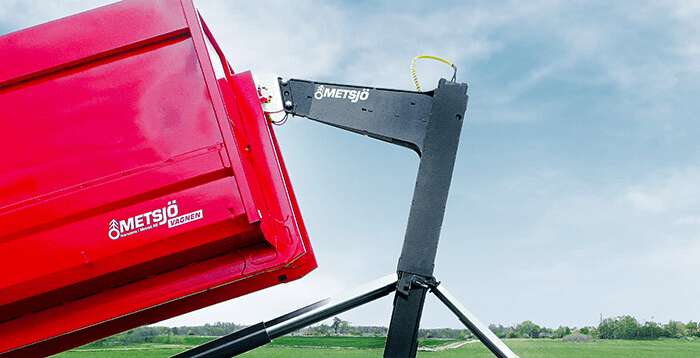
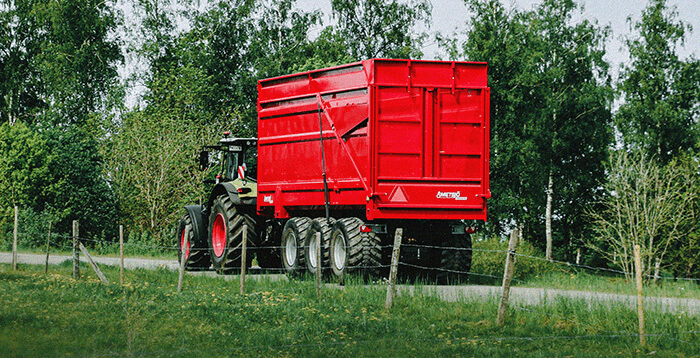

In an independent study conducted by RISE and Linköping University, it was measured that Metsjö's hi-tech trailers can transport double the load with up to 46% lower soil pressure in the topsoil – and 65% lower subsoil compaction in the subsoil – compared to conventional trailers with truck tyres. The study is one of few independent soil compaction tests conducted on modern tractor-drawn trailers under real field conditions.
Tyre choice on a tractor-drawn trailer or hook lift trailer matters more than most people think. A wide, large tyre with low inflation pressure cushions, provides grip, stabilises the rig and protects the soil. A narrow, small tyre with high pressure sinks in, compacts underlying soil layers and limits trafficability in wet terrain. The difference can be measured in yield, driving damage and operability under difficult conditions.
Metsjö offers the widest selection of tyres on tractor-drawn trailers and hook lift trailers – including the widest tyres within 2,550 mm in combination with a steered rear axle. This is made possible by a combination of design choices unique to Metsjö: narrow chassis geometry, hydraulic suspension and laser-aligned axles.
Within 2,550 mm, Metsjö can offer 18% wider tyres on trailers and 27% wider tyres on hook lift trailers compared to what most competitors can achieve – and this in combination with a steered rear axle, which is unique on the market.
Soil compaction is one of agriculture's most costly problems. Subsoil compaction can persist for decades and directly reduce yields. There is a rule of thumb in soil compaction research – the "50/50 rule" – which states that vertical stresses in the soil profile should not exceed 50 kPa (0.5 bar) at more than 50 cm depth at field capacity. With the right tyres, the right inflation pressure and the right number of axles, this is achievable even with heavy loads.
What determines soil compaction?
The RISE study provides an important pedagogical insight that most farmers are not aware of:
The optimal combination is therefore: wide VF tyres + low inflation pressure + more axles. This is precisely what Metsjö's hi-tech trailers offer.

Independent measurements from RISE and Linköping University
In the study, Metsjö's trailers were tested against a conventional two-axle trailer with truck tyres. The results:
| Trailer | Axles | Total weight | Wheel load | Inflation pressure | Soil pressure 25 cm | Soil pressure 60 cm |
|---|---|---|---|---|---|---|
| Conventional | 2 | 15 tonnes | 3,750 kg | 5.0 bar | 0.97 bar | – |
| MetaQ75 | 3 | 30 tonnes | 3,750 kg | 2.0 bar | 0.63 bar | – |
| MetaQ75 | 3 | 30 tonnes | 3,750 kg | 1.0 bar | 0.65 bar | 0.23 bar |
| MetaFlex 60-75 4X | 4 | 33 tonnes | 5,000 kg | 1.5 bar | 0.55 bar | – |
| MetaFlex 60-75 4X | 4 | 33 tonnes | 5,000 kg | 1.0 bar | 0.52 bar | 0.08 bar |
Three insights stand out:
MetaQ75 with double the load gives 35% lower soil pressure in the topsoil. Despite 30 tonnes total weight – double the conventional trailer – and wide implement tyres at 2.0 bar inflation pressure, 0.63 bar soil pressure is achieved compared to 0.97 bar. Tyre width plays a greater role than inflation pressure in the topsoil – the difference between 2.0 and 1.0 bar inflation pressure on the MetaQ75 is only marginal (0.63 vs 0.65 bar).
MetaFlex 60-75 4X with four axles gives almost half the soil pressure. At 1.0 bar inflation pressure and 33 tonnes total weight, 0.52 bar is measured – 46% lower than the conventional trailer despite more than double the load.
At 60 cm depth, the number of axles is decisive. MetaQ75 with three axles gives 0.23 bar at 60 cm depth. MetaFlex 60-75 4X with four axles gives only 0.08 bar – 65% lower deep compaction thanks to the load being distributed across more axles despite the total weight being higher.
Trafficability in terrain
A wider tyre floats on soft ground instead of sinking in. It reduces rolling resistance, increases trafficability in wet terrain and means the rig can be operated under conditions where narrower tyres get stuck. In combination with driven axles – described in the article on driven axles – wide tyres provide exceptional trafficability even in the most demanding terrain.
Cushioning and comfort
A large tyre with low inflation pressure acts as a natural spring and absorbs shocks from uneven ground. It reduces the load on the chassis, axles and cargo – and makes driving more comfortable for both trailer and tractor.
Stability
Wider tyres provide a wider track and a lower centre of gravity relative to track width, which increases the rig's lateral stability on slopes and uneven ground.

Narrow chassis geometry
Metsjö's unique geometry – described in detail in the geometry article – means the chassis can be built narrower than on trailers with conventional construction. This creates space for wider tyres within 2,550 mm.
Hydraulic suspension with chassis height adjustment
On MetaFlex models with hydraulic suspension, the chassis height can be adjusted directly from the operator's seat – this is standard functionality. It is a prerequisite for the very widest tyres on hook lift trailers: when a body tips or is exchanged on a hook lift trailer, it must pass the wheels, and with the widest tyres the chassis needs to be in a raised position for the body to clear. Without the ability to adjust chassis height, it would not be possible to combine the widest tyres with the hook lift function.
Laser-aligned axles
Metsjö's axles are laser-aligned with absolute precision during assembly. This means the wheels run exactly parallel, lateral friction is minimised and rolling resistance is kept to a minimum – one of the design choices that contributes to Metsjö's documented low rolling resistance described in the payload article.
2,550 mm is the maximum construction width for tractor-drawn vehicles on public roads in Norway and several other countries. Tyres wider than this require special permits for road use.
Table explanation: Outside diameter = the tyre's total diameter in mm. Width = the tyre's section width in mm.
The following tyre sizes can be fitted within 2,550 mm in combination with a steered rear axle – a combination unique on the market:
| Tyre | Outside diameter (mm) | Width (mm) | Comment |
|---|---|---|---|
| 385/65R22.5 158L | 1,070 | 389 | |
| 500/50R17 149D/146E | 932 | 500 | |
| 445/65R22.5 169K | 1,150 | 444 | |
| 455/40R22.5 160J | 940 | 453 | |
| 560/45R22.5 IMP 152D | 1,080 | 564 | |
| 560/60R22.5 IMP 161D | 1,240 | 564 | |
| VF 560/60R22.5 IMP 166D | 1,240 | 542 | VF variant – lower inflation pressure at the same load capacity |
| 600/50R22.5 IMP 159D | 1,170 | 591 | |
| 650/50R22.5 IMP 168D | 1,220 | 645 | |
| 710/35R22.5 IMP 157D | 1,070 | 712 | Hydraulic brakes only within 2,550 mm – air brakes can be used outside this width |
| 710/45R22.5 IMP 165D | 1,210 | 706 | Hydraulic brakes only within 2,550 mm – air brakes can be used outside this width |
| 600/55R26.5 IMP 165D | 1,330 | 591 | |
| VF 600/55R26.5 IMP 170D | 1,340 | 626 | VF variant – lower inflation pressure at the same load capacity |
| 650/55R26.5 IMP 169D | 1,390 | 645 | |
| VF 650/55R26.5 IMP 174D | 1,400 | 649 | VF variant – lower inflation pressure at the same load capacity |
| 710/50R26.5 IMP 170D | 1,380 | 706 | Increased chassis height |
| VF 710/50R26.5 IMP 173D | 1,400 | 732 | VF variant – lower inflation pressure at the same load capacity. Increased chassis height |
| 710/50R30.5 IMP 173D | 1,490 | 727 | Increased chassis height |
For customers who purchase trailers and hook lift trailers for use where wider tyres are permitted, Metsjö can fit even wider tyres. EU type-approval
permits tyres up to 3,000 mm wide – it is the trailer's construction width that limits, not the type-approval or the tyre size itself:

| Tyre | Outside diameter (mm) | Width (mm) |
|---|---|---|
| 800/40R22.5 IMP 168D | 1,210 | 828 |
| 750/45R26.5 IMP 170D | 1,350 | 754 |
| VF 750/45R26.5 IMP 176D | 1,360 | 750 |
| 800/45R26.5 IMP 174D | 1,390 | 808 |
| 800/45R30.5 IMP 176D | 1,500 | 808 |
| 850/50R30.5 176D | 1,624 | 850 |
Wide tyres give the greatest effect when inflation pressure is adapted to the situation – high pressure on the road for load-bearing capacity and safety, low pressure in the field for minimal soil compaction and better trafficability. Tyre pressure regulation makes it possible to adjust inflation pressure without leaving the tractor.

The combination of wide tyres and tyre pressure regulation is particularly powerful:
As described in the steering article, steered axles are in practice a requirement when operating at low inflation pressure – without steering, the wide tyre is forced to scrub sideways with heavy lateral loading as a result. The combination of wide tyres, tyre pressure regulation and steered axles is therefore the optimal solution for farmers who want to minimise soil compaction without compromising trafficability or load capacity.
The same applies in combination with driven axles – low pressure provides maximum contact area and traction, driven axles provide traction directly under the load.
Wide tyres combine optimally with Metsjö's hydraulically driven axles. Driven axles provide traction directly under the load and prevent the rig from getting stuck – wide tyres reduce sinkage and increase ground contact area. Together they provide a rig that can handle terrain that most competitors cannot match. Read more in the article on driven axles.
| Feature | Metsjö | Most competitors |
|---|---|---|
| Max tyre width within 2,550 mm – trailers | 732 mm (VF 710/50R26.5) | ~600 mm |
| Max tyre width within 2,550 mm – hook lift trailers | 732 mm (VF 710/50R26.5) | ~560 mm |
| Steered rear axle + widest tyres within 2,550 mm | Yes – unique on the market | No |
| Chassis height adjustment from operator's seat | Yes – standard with hydraulic suspension | Rarely |
| Tyres wider than 2,550 mm | Up to 850 mm width | Up to approx. 710 mm |
| Combination with driven axles | Yes | Rarely |
| Combination with tyre pressure regulation | Yes | Yes |
| Independent scientific soil compaction measurements | Yes – RISE/LiU study | Not published |
What is the 2,550 mm limit?
2,550 mm is the maximum construction width for tractor-drawn vehicles on public roads in Norway and several other countries. Tyres wider than this require special permits for road use. Metsjö's design maximises tyre width within this limit – but can also supply wider tyres for customers operating in environments where this is permitted or desired.
What determines soil compaction – tyre width or inflation pressure?
Both matter but at different depths. In the topsoil (0–30 cm), it is primarily tyre width and inflation pressure that determine soil pressure – wide tyres with low inflation pressure provide a large contact area and spread the load. At depth in the subsoil (30–60 cm), it is wheel load per axle that is decisive – more axles give lower wheel load and markedly lower deep compaction. The RISE/LiU study shows that the difference between 2.0 and 1.0 bar inflation pressure on the MetaQ75 was marginal in the topsoil, but the difference between three and four axles gave 65% lower soil pressure at 60 cm depth.
How can Metsjö's trailers with double the load give lower soil compaction?
It is the combination of wide implement tyres, low inflation pressure and more axles that determines this – not the total weight itself. In an independent study conducted by RISE and Linköping University, it was measured that MetaQ75 with 30 tonnes total weight and modern implement tyres at 2.0 bar inflation pressure gave 35% lower soil pressure in the topsoil compared to a conventional two-axle trailer with only 15 tonnes load and truck tyres at 5.0 bar inflation pressure. MetaFlex 60-75 4X with four axles and 33 tonnes total weight at 1.0 bar inflation pressure gave 46% lower soil pressure in the topsoil and 0.08 bar at 60 cm depth – against 0.23 bar for the three-axle trailer.
Why can air brakes not be used with 710/35R22.5 and 710/45R22.5 within 2,550 mm?
The air brake system's brake drum does not fit in the wheel rim on these tyres when fitted within 2,550 mm construction width. Outside this limit, air brakes can be used on these tyre sizes as well. Within 2,550 mm they are fitted with hydraulic brakes, which is a fully adequate alternative.
Why is increased chassis height needed with the widest tyres on hook lift trailers?
When a body tips or is exchanged on a hook lift trailer, it must pass the wheels. With the widest tyres – 710/50R26.5, VF 710/50R26.5 and 710/50R30.5 – the chassis needs to be in a raised position for the body to clear. On MetaFlex with hydraulic suspension, chassis height adjustment is standard and is done directly from the operator's seat.
What are VF tyres?
VF (Very high Flexion) is a tyre standard that permits 40% lower inflation pressure than a conventional tyre at the same load capacity – or up to 40% higher load capacity at the same inflation pressure. VF tyres in combination with tyre pressure regulation are the optimal solution for minimising soil compaction with heavy loads.
Can I combine wide tyres with a steered rear axle?
Yes – and this is unique to Metsjö. Most competitors cannot offer the widest tyres in combination with a steered rear axle within 2,550 mm. Metsjö's narrow chassis geometry makes it possible. Read more in the steering article.
Why are steered axles important at low tyre pressure?
At low inflation pressure, the tyre's lateral stiffness decreases markedly. Without steering, the wide tyre is forced to scrub sideways in corners with heavy lateral loading as a result – this damages the soil and wears the tyre abnormally quickly. Steered axles are in practice a requirement when operating at low inflation pressure with wide tyres.
Can wide tyres be combined with driven axles?
Yes – and the combination is unique on the market. Driven axles provide traction directly under the load and wide tyres reduce sinkage and increase contact area. Together they provide maximum trafficability in difficult terrain. The combination also works excellently with tyre pressure regulation – low pressure in the field provides maximum contact area and traction.
Which tyre gives the lowest soil compaction?
It depends on the application. In general, more axles, wider tyres and lower inflation pressure give the lowest soil compaction. As a guide:
Always combine with steered axles at low inflation pressure and driven axles when extra traction is needed.
Why do more axles give lower soil compaction at depth?
More axles distribute the load across more wheels, which reduces wheel load per axle. In the RISE/LiU study, it was wheel load – not total weight – that was decisive for soil pressure at 60 cm depth at equal inflation pressure. MetaFlex 60-75 4X with four axles gave 0.08 bar at 60 cm depth – 65% lower than MetaQ75 with three axles which gave 0.23 bar, despite MetaFlex 60-75 4X having a higher total weight. More axles is the most effective way to protect the subsoil against deep compaction.
Want to know which tyre sizes suit your application best? Contact us or your nearest Metsjö dealer – we will help you find the right combination of tyre size, brake system and chassis configuration.