
The Metsjö Technology
The Metsjö Technology




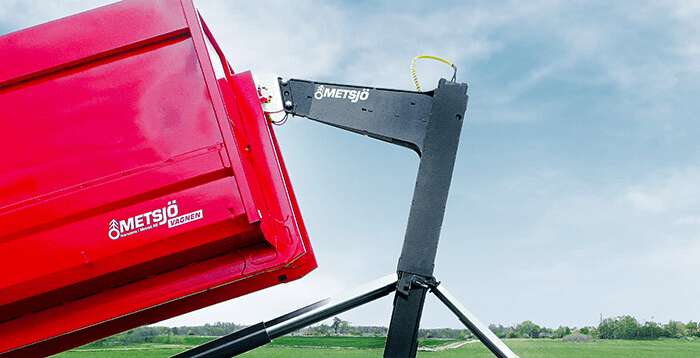
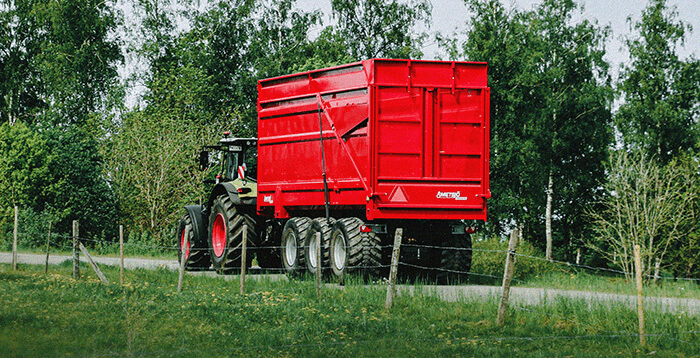

A well-designed steering system on a tractor-drawn trailer or hook lift trailer does more than follow the tractor around corners. It protects the grass sward and soil surface, reduces tyre wear, improves manoeuvrability in confined spaces and determines whether the rig can be reversed and manoeuvred efficiently in practical situations – such as exchanging a container on a tight farmyard or driving along the edge of a grass field without leaving tracks.
Metsjö builds its trailers and hook lift trailers with a carefully considered three-level steering option structure – from basic self-steering in float mode to fully automatic contactless steering via HYDAC ADSteer. The right system depends on trailer length, application and how much automation the operator requires.
Note: Automatic steering goes by many different names depending on the manufacturer – common terms include electro-hydraulic forced steering, electronic forced steering, Electronic Power Steering (EPS) and Dynamic Trailer Steering. At Metsjö we use HYDAC ADSteer. All these systems refer to the same fundamental technology: active electro-hydraulic steering of the axles without mechanical connection to the tractor.
When a tractor-drawn rig corners, lateral forces act on the axles. Without steering on the rear axles, the tyres are forced to scrub sideways – wearing the rubber, cutting deep tracks in soft ground and loading the axles harder than necessary.
A steered axle instead follows the geometry of the curve and rolls along its natural path:
Steered axles → Less lateral scrub → Lower tyre wear → Less soil damage → Better manoeuvrability → Lower operating costs
In concrete terms this means:
Before describing the steering levels it is important to understand what makes Metsjö's axle design unique – because good steering starts long before any hydraulic system is connected.
BPW GSLA self-steering axles
Metsjö uses BPW GSLA axles with undulated thrust bearings. The principle is elegant: when the rig travels straight ahead, the wave-shaped profile of the bearing and the vehicle's own weight keep the wheels stable in the zero position. When the tractor turns, the castor angle of the wheels follows the curve geometry and the axle steers smoothly into the bend – without any external power supply and without external stabilising elements. With optional equipment, up to 28 degrees of steering angle is achievable.

Laser-aligned axles from BPW
Metsjö's axles are laser-aligned with absolute precision during assembly. This means the wheels run exactly parallel, lateral friction is minimised and rolling resistance is kept to a minimum. Combined with BPW's undulated thrust bearing principle, this produces trailers that roll exceptionally freely and responsively – something confirmed by JTI's independent study Energibesparande teknik för lantbrukets transportlogistik, and something our customers frequently notice immediately when switching from another manufacturer.
Float valves mounted directly on the axle
A technical detail that sets Metsjö apart from most competitors: our float valves are mounted directly on the axle rather than in a separate hydraulic block further away in the system. This means the axle responds immediately to terrain variations without delay in the hydraulic system. The float mode becomes more responsive and the axle reads the ground more dynamically – one of the reasons Metsjö trailers often perform well without automatic steering in applications where competitors cannot practically deliver longer trailers without it.
Optimised axle placement and weight transfer
Metsjö positions the axles based on the trailer's geometry and optimises weight transfer to the tractor at 3–4 tonnes. Many competitors place the axles far rearward to save on the suspension construction – but this often results in the trailer cutting more in corners and being less responsive. Metsjö's axle placement combined with shorter overall length means the rig follows the tractor more naturally.
Adjustable track width
Metsjö can adjust the track width via wheel offset so that the trailer optimally follows the tractor's wheel tracks. This is particularly valuable in combination with GPS-guided tractors and precision farming, where it is important that the trailer runs exactly in the tractor's tracks to minimise driving damage to the grass sward and cropping area.

On most Metsjö models, a steered axle is standard:
In standard mode, the axle runs in float when travelling forward. This means the axle freely follows the curve geometry using the castor angle of the wheels and BPW's undulated thrust bearing principle – without hydraulic pressure actively steering. The axle is activated using the tractor's hydraulic controls. When reversing – or when needed during forward travel – pressure is applied to the axle and it straightens to a fully straight position, giving stable reversing without the steering axle steering in the wrong direction.
Thanks to the float valves mounted directly on the axle, Metsjö's float mode is more responsive than competitors where the valves are located further away in the hydraulic system.
Manual forced steering – also known as manual forced steering – gives the operator active control of the steering axle via electrical controls. The system is activated either via a control box in the cab or via a separate three-pin connector.
Basic function:
Options within level 2:
Straightening and locking – the axle can be straightened to fully straight and locked in that position. Useful when reversing on narrow roads or in situations where predictable straight-line behaviour is required.
Crab steering (Dogwalk) – all axles are steered in the same direction simultaneously, causing the rig to move sideways. Crab steering is particularly valuable when protecting sensitive fields. When driving on grass swards it is essential that the wheels follow exactly the same tracks run after run – otherwise the grass is damaged and the next cut is affected. With crab steering the rig can be shifted sideways to stay in the correct tracks without the wheels scrubbing into the sward. In potato growing the same principle allows driving along the rows without damaging the crop. Crab steering is also used when positioning alongside walls, loading docks or in confined farmyards.
The highest steering level is fully automatic electro-hydraulic steering via HYDAC ADSteer Profi – also known under industry terms including electronic forced steering, electro-hydraulic forced steering and Electronic Power Steering (EPS). The system activates steering automatically without any input from the operator.
What makes HYDAC ADSteer unique: no mechanical connection to the tractor
Earlier generations of automatic steering relied on:
All of these required precise connection, risked incorrect connection and in some cases required modification of the tractor. Changing the towing vehicle was often a cumbersome procedure.
ADSteer Profi solves this through contactless angle measurement. A HYDAC HIT 1500 gyro inclination sensor is mounted on the trailer chassis and measures the trailer's rate of rotation around the Z-axis. Combined with travel speed – measured by two redundant speed sensors – the system's control unit (HYDAC HY-TTC 32S) calculates the target angle for the steering axles in real time based on the trailer's geometric data.

The result: No cable. No rod. No special coupling on the tractor. The only connection to the towing vehicle is standard ISOBUS and LS hydraulics.
ADSteer compared with previous generations of automatic steering
| Property | Cable/rod | Sensor at drawbar/top link | HYDAC ADSteer |
|---|---|---|---|
| Mechanical connection to tractor | Yes | Yes | No |
| Tractor modification required | Often | Sometimes | No |
| Operates at 60 km/h | Rarely | Sometimes | Yes – PL d certified |
| Susceptible to incorrect connection | High risk | Some risk | No risk |
| Service without leaving cab | No | No | Yes – via ISOBUS display |
| Crab steering possible | No | Possible | Possible |
| Flexible when changing tractor | No | Limited | Yes – independent of towing vehicle |
ADSteer operating modes:
Automatic steering when reversing
One of the most practical advantages of ADSteer is how the system handles reversing. Without automatic steering, the operator must actively think about the steering axle position when backing the rig – for example when exchanging a container on a tight farmyard or when connecting to a loading dock. With ADSteer the system steers the axles automatically even when reversing, meaning the rig follows the correct path without any manual adjustment from the operator. This reduces the risk of misjudgement and makes reversing with long rigs significantly easier and safer.
Track following and precision farming
With ADSteer the trailer follows the tractor's tracks with high precision – particularly valuable for farmers using GPS-guided tractors. When the tractor maintains an exact GPS-guided track it is important that the trailer does the same, otherwise unnecessary driving damage occurs outside the track. ADSteer ensures the trailer consistently follows in the tractor's wheel tracks. Combined with Metsjö's ability to adjust track width via wheel offset, the rig can be optimised to exactly match the tractor's track width – a feature that directly reduces ground impact in precision farming.
Approved for 60 km/h – safe across the full speed range
HYDAC ADSteer is designed and certified for use at high speeds, making it the natural choice on Metsjö's EU type-approved trailers and hook lift trailers. All MetaQ models and MetaFlex models with hydraulic suspension are EU type-approved for travel at up to 60 km/h. At these speeds it is essential that the steering operates stably and predictably – ADSteer automatically reduces the steering angle as speed increases and guarantees safe steering up to and including 60 km/h without risk of oversteering or instability.
Simpler steering systems are often designed primarily for low speeds and field use. ADSteer is certified across the full speed range – from crawl speed on soft ground to full road speed – making it unique among automatic steering systems in its class.
Serviceability and operational reliability
ADSteer is designed for straightforward service without leaving the tractor. If the trailer needs to be re-calibrated, a new centre can easily be generated directly via the tractor's ISOBUS display – without specialist tools and without the operator having to leave the cab. If a fault occurs, the system displays clear fault codes in the display that directly identify where in the system the problem lies – minimising diagnostic time and simplifying service.
The system is also significantly more stable and reliable than previous generations of automatic steering. The mechanical couplings and cables that were common failure points in earlier systems have been completely eliminated – ADSteer has no moving external components that can wear out or be damaged in the field.
Display and control via ISOBUS
The system is displayed and controlled via ISOBUS – either through the tractor's factory-installed terminal or via an external display. A factory-installed ISOBUS terminal on the tractor is therefore not required.
Safety level
HYDAC ADSteer meets functional safety requirements up to PL d according to EN ISO 13849 and AgPL d according to ISO 25119 – the highest levels for mobile working machines. The redundant Cat 3 sensor architecture and the closed-loop control circuit with angle feedback on the steering axles guarantee reliable steering across the full speed range, from field use to 60 km/h on the road.
A growing number of farmers use tyre pressure regulation systems that lower inflation pressure in the field for reduced soil compaction and raise it again on the road for better load-bearing capacity and safety. It is one of the most effective methods for protecting soil structure and increasing yields on sensitive soils.
When operating at low inflation pressure, the tyre's contact patch width increases and its lateral stiffness decreases significantly. This means steered axles become a practical requirement – without steering, the wide tyre is forced to scrub sideways with heavy lateral loading as a consequence, which both damages the soil and wears the tyre abnormally quickly.
With steered axles the system operates correctly even at low inflation pressure. Automatic steering with ADSteer further reduces lateral forces and ensures the axles always follow the correct path – regardless of inflation pressure and ground conditions. For operators who have invested in tyre pressure regulation, automatic steering is therefore the natural next step to maximise the benefit of the system and minimise both soil impact and tyre wear.
Metsjö can combine automatic steering (HYDAC ADSteer) with hydraulically driven axles in the same rig – a very unusual combination in the industry. The two systems operate completely independently of each other – both communicate via ISOBUS but do not affect each other's function.
For farmers and contractors working in extremely demanding terrain, the combination delivers maximum trafficability: the driven axles provide traction directly under the load when the tractor alone is not sufficient, while ADSteer ensures the rig corners correctly and gently even in wet and soft conditions. Together they eliminate the two most common reasons rigs become stuck or are forced to stop – insufficient traction and incorrect steering in difficult terrain.
For more information on driven axles, see our article on hydraulically driven axles on trailers and hook lift trailers.
Automatic steering is not right for everyone – and it is important to be clear about that. Here is a practical guide:
Self-steering in float mode is often sufficient for:
Manual forced steering is right when:
Automatic steering with ADSteer is right when:
At Metsjö it is the base design – shorter trailers, laser-aligned BPW axles, float valves mounted directly on the axle and optimised axle placement – that determines how much steering you actually need. Some competitors cannot in practice deliver longer trailers without automatic steering. Metsjö can offer a responsive rig already at level 1 or 2 – and automatic steering is an option that adds real value when the application genuinely calls for it.
| Level | Name | Activation | Best for |
|---|---|---|---|
| 1 | Self-steering in float mode | Hydraulic controls | Normal transport on well-designed rigs |
| 2 | Manual forced steering | Control box / ISOBUS | Reversing, crab steering, specific situations |
| 3 | Automatic steering – HYDAC ADSteer | Automatic | Long trailers, container exchange, 60 km/h, extreme agility |
Why does a tractor-drawn trailer need steering?
Without steering on the rear axles, the tyres are forced to scrub sideways in corners – wearing the rubber, damaging the grass sward and loading the axles harder than necessary. A steered axle follows the curve geometry and rolls along its natural path, reducing wear and ground impact.
What is the difference between float mode and forced steering?
In float mode the axle steers freely based on the castor angle of the wheels and terrain geometry without active hydraulic steering. Forced steering means the operator – or the system automatically – actively steers the axle via electrical controls and the tractor's hydraulics.
What do other manufacturers call automatic steering?
The technology can be marketed under many different names – common terms include electronic forced steering, electro-hydraulic forced steering, Electronic Power Steering (EPS), Dynamic Trailer Steering (DTS) and SteerX. All these systems are based on the same fundamental principle: active electro-hydraulic steering without mechanical connection to the tractor. At Metsjö, HYDAC ADSteer is used.
What is crab steering (dogwalk)?
Crab steering means all steering axles point in the same direction simultaneously, causing the rig to move sideways. It is particularly valuable for protecting sensitive fields – when driving on grass swards it is essential that the wheels follow exactly the same tracks run after run, otherwise the grass is damaged and the next cut is affected. In potato growing, the same principle allows driving along the rows without damaging the crop. Crab steering is also used when positioning alongside walls, loading docks or in confined farmyards.
Why is steering especially important at low tyre pressure?
When operating at low inflation pressure – for example with a tyre pressure regulation system for lower soil compaction – the tyre's contact patch increases and lateral stiffness decreases. This means unsteered axles are forced to scrub sideways with heavy lateral loading as a consequence, which damages the soil and wears tyres abnormally quickly. Steered axles are in practice a requirement when operating at low inflation pressure. Automatic steering with ADSteer further reduces lateral forces and is the natural complementary step for anyone who has invested in tyre pressure regulation.
What makes HYDAC ADSteer different from earlier automatic steering systems?
Earlier systems required mechanical connection to the tractor via cable, rod or special coupling. ADSteer calculates the target angle for the steering axles contactlessly via a gyro inclination sensor and travel speed – no mechanical connection to the towing vehicle is needed beyond standard ISOBUS and LS hydraulics. The system is also significantly more stable and reliable than earlier generations and displays clear fault codes in the ISOBUS display if a fault occurs – without the operator having to leave the cab.
Is ADSteer safe at 60 km/h?
Yes. HYDAC ADSteer meets functional safety requirements up to PL d according to EN ISO 13849 and AgPL d according to ISO 25119 – the highest levels for mobile working machines – and is designed for the full speed range up to 60 km/h. The steering angle is automatically reduced as speed increases to guarantee stability. This makes ADSteer the natural choice on Metsjö's EU type-approved MetaQ and MetaFlex models with hydraulic suspension.
Can the trailer be adjusted to follow the tractor's exact wheel tracks?
Yes – Metsjö can adjust the track width via wheel offset so the trailer runs in exactly the same tracks as the tractor. This reduces ground impact and is particularly valuable when driving on grass swards and in precision farming with GPS-guided tractors. Combined with ADSteer ensuring the trailer follows the tractor's tracks dynamically in corners, this is a unique offering in its class.
Does the tractor need factory-installed ISOBUS to use ADSteer?
No. The system is displayed and controlled via ISOBUS but an external display can be used on tractors without a factory-installed ISOBUS terminal.
Can automatic steering be combined with driven axles?
Yes – Metsjö can combine automatic steering with hydraulically driven axles in the same rig, a very unusual combination in the industry. The two systems operate completely independently of each other and together deliver maximum trafficability in demanding terrain: driven axles for traction and ADSteer for correct and gentle steering.
Why do Metsjö trailers have better base steering than competitors'?
The combination of BPW GSLA axles with undulated thrust bearing principle, float valves mounted directly on the axle, laser-aligned axles and optimised axle placement delivers a naturally responsive behaviour that most competitors do not achieve. This means Metsjö can manage with a lower steering level for the same application.
What do I save in fuel per year with a trailer with good base steering?
It depends on the application, distance and amount of cornering. A well-functioning steered axle significantly reduces lateral scrub in corners and directly reduces tyre wear. Metsjö trailers already have lower tyre wear than competitors' thanks to the base design – automatic steering reduces it further.