The Metsjö Technology
The Metsjö Technology




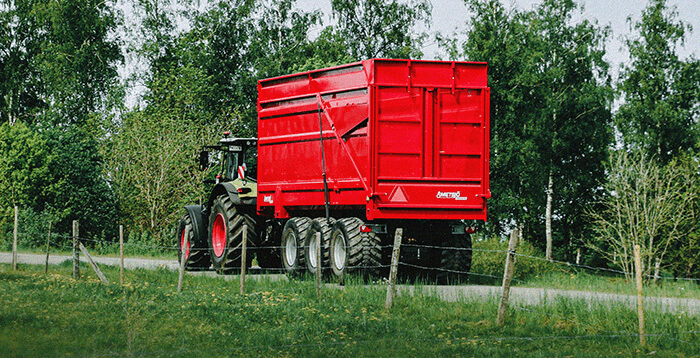

Stability, safety and precision in real-world operation
The choice of suspension is critical to how a tractor-towed trailer or hooklift performs under real operating conditions. The right suspension system affects not only driver comfort and safety, but also fuel consumption, tyre wear, soil compaction and the trailer’s long-term resale value.
At Metsjö, suspension is a core part of the overall design. Our philosophy is clear: stability, control and precision always come before cheaper solutions and lateral softness. Below we explain the differences between hydraulic suspension and air suspension – and why Metsjö’s hydraulic suspension sets a new benchmark for agricultural trailers and hooklift systems.
A modern agricultural trailer or tractor-towed hooklift is exposed to loads and conditions rarely encountered by conventional road vehicles:
Extreme loads with a high centre of gravity, for example during silage or container transport
Uneven terrain, soft fields and high demands on soil protection
Rapid transitions between empty and fully loaded operation
Relatively high transport speeds on poor road surfaces
In these environments, lateral stability of the suspension system is essential for both safety and operational economy.
Parabolic suspension based on leaf springs is a common mechanical solution in the industry. However, Metsjö does not build trailers with parabolic suspension.
The reason is simple:
leaf springs provide insufficient lateral control. Under heavy loads and on uneven ground this can lead to oscillation and instability, creating safety limitations when handling high loads, tall bodies or demanding terrain.
Metsjö offers air suspension for trailers where transport comfort and automatic ride height adjustment are prioritised. The system is based on standard components from the truck industry and is generally less expensive than hydraulic suspension.
Advantages of air suspension:
Excellent comfort during road transport
Automatic ride height, especially beneficial with stiff tyres
Low vibration levels on smooth surfaces
Metsjö standard:
All air-suspended axles are laser-aligned during installation, ensuring straight tracking, reduced rolling resistance and minimal tyre wear.
Limitations of air suspension:
Air is compressible, making the system elastic
Tall containers or hooklift bodies can cause lateral sway
Reduced stability affects both safety and resale value
Air bellows are sensitive to punctures and rough terrain, making air suspension less suitable for demanding field conditions
Hydraulic suspension is the foundation of Metsjö’s most successful trailer concepts. Because hydraulic oil is incompressible, the system delivers direct, stable and predictable behaviour regardless of load or driving conditions.
Suspension is achieved through controlled oil flow and a chassis design that actively manages forces both longitudinally and laterally.
1. Laser-aligned axles
Extremely precise axle installation reduces lateral forces, lowers fuel consumption and allows the trailer to roll more freely than conventional solutions.
2. Angled hydraulic cylinders
The cylinder geometry provides the widest possible stability base within legal width limits, delivering outstanding roll stability in corners and on slopes.
3. Dual hydraulic circuits (left/right)
The system efficiently manages uneven loads. On Metsjö hooklifts, the left and right sides can also be raised or lowered individually from the driver’s position, enhancing both safety and ease of use.
Because the chassis height can be adjusted via the hydraulic suspension, MetaQ models allow easy body changes: the chassis is raised, support legs are deployed and tipping joints released. The vehicle can then drive under another body, enabling highly efficient use of the chassis for different crops or dump operations.
Metsjö’s hydraulic suspension is not only stable – it is also highly energy efficient.
An independent study conducted by JTI (Swedish Institute of Agricultural and Environmental Engineering) shows that a Metsjö MetaQ 75 consumes approximately 25% less fuel than a conventional trailer.
Why?
Precise wheel geometry and controlled load distribution minimise energy losses over every metre driven.
A study by RISE (Research Institutes of Sweden) confirms the importance of Metsjö’s chassis concept for soil health.
A fully loaded MetaQ 75 produced approximately 50% lower ground pressure than a conventional trailer
This despite carrying twice the load
Conclusion:
Chassis design, weight distribution and suspension are at least as important as tyre choice when it comes to reducing subsoil compaction.
For operators who want both transport comfort and maximum stability, Metsjö offers active hydraulic suspension with accumulator tanks.
Empty trailer: Accumulators provide soft, compliant ride similar to air suspension
Heavy load: The system automatically stiffens, delivering uncompromising stability when it matters most
Choosing the right suspension is a long-term decision.
Even if the first owner does not intend to operate tall bodies or containers today, future users may – making stable suspension critical for both safety and resale value.
Why choose hydraulic suspension from Metsjö?
Safety: Active roll stability reduces rollover risk
Economy: Lower fuel consumption and reduced tyre wear
Precision: Laser-aligned geometry for perfect tracking
Functionality: Independent left/right adjustment simplifies daily work and body changes
Want to know which suspension system best suits your operation?
Contact Metsjö for technical advice based on real operating conditions.