
The Metsjö Technology
The Metsjö Technology




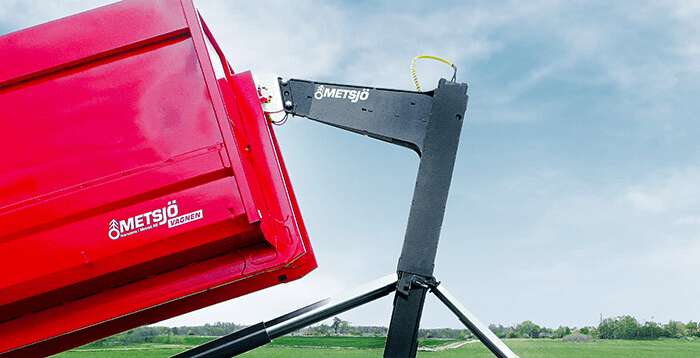
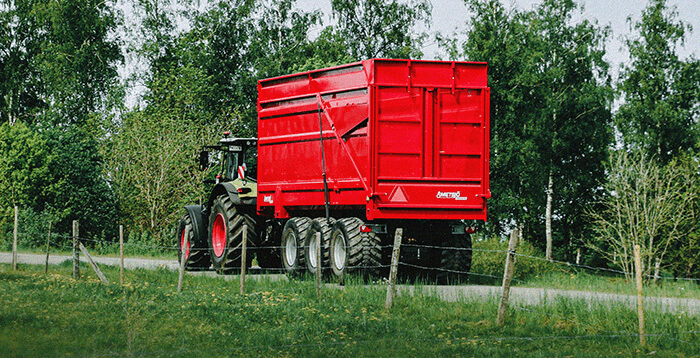

In modern agriculture and heavy-duty transport operations, margins are tight and efficiency requirements continue to increase. When investing in a new trailer, it is easy to focus on body volume or purchase price. However, there is one figure in the specification sheet that influences profitability every single day, both in the field and on the road: tare weight.
Metsjö's engineering philosophy is reflected throughout the entire product range – MetaFlex hook lift trailers, MetaQ tipping trailers, MetaBale bale trailers and MetaK push-off trailers. By integrating the chassis and functional systems into one cohesive structure, using high-strength steel and applying a heat-free surface treatment process, we build trailers that deliver more payload per kilogram of tare weight than comparable alternatives on the market – without compromising structural strength or service life.
On the road, low tare weight increases legal payload. In the field, it means lower ground pressure, improved mobility and the ability to transport more crop before either the tractor or the soil reaches its limits. Independent studies from RISE and JTI have demonstrated approximately 25% lower fuel consumption and 50% lower soil compaction compared to conventional trailers with similar carrying capacity.
This article explains the engineering principles behind these results – and why every kilogram saved is a direct benefit to your business.

Every vehicle combination is limited by legal gross vehicle weight regulations. Metsjö's three-axle MetaQ75 and MetaFlex 60–75 trailers are EU type approved for a maximum gross vehicle weight of 34 tonnes.
The principle is simple:
The lighter the trailer, the more product you can transport legally.
| Model | Tare Weight | Available Payload | Advantage |
|---|---|---|---|
| MetaFlex 60–75 | 5.8 t | 28.2 t | +4.1 t per trip |
| Typical market level | approx. 9.9 t | approx. 24.1 t | – |
| Model | Tare Weight | Available Payload | Advantage |
|---|---|---|---|
| MetaQ75 | 7.02 t | 26.98 t | +2.68 t per trip |
| Typical market level | approx. 9.7 t | approx. 24.3 t | – |

Payload efficiency measures how much useful cargo a trailer can transport relative to its own weight. It is one of the most meaningful ways to compare different trailer concepts and one of the clearest indicators of engineering efficiency.
| Model | Tare Weight | Payload | Payload Ratio |
|---|---|---|---|
| MetaFlex 60–75 | 5.8 t | 28.2 t | 4.9 : 1 |
| Typical market level | 9.9 t | 24.1 t | 2.4 : 1 |
| MetaQ75 | 7.02 t | 26.98 t | 3.8 : 1 |
| Typical market level | 9.7 t | 24.3 t | 2.5 : 1 |
MetaFlex 60–75 transports almost five tonnes of product for every tonne of trailer weight. A comparable trailer at typical market level transports less than two and a half tonnes.
This ratio directly determines:
Number of trips required
Fuel consumption
Wear on tractor and trailer
Overall transport costs
Every kilogram of tare weight that does not contribute to payload must still be accelerated, braked, pulled through the field and transported on the road.
In JTI's independent study Energy Efficient Technology for Agricultural Transport Logistics, Metsjö's trailer was compared with simpler trailer concepts under real operating conditions.
The study found fuel consumption increased by:
Approximately 0.21 litres per hour per tonne of load during road transport
Approximately 0.24 litres per hour per tonne of load during field operation
It is important to note that these figures are measured in litres per hour. The difference between road and field operation appears relatively small because tractors travel significantly slower in the field.
Per kilometre, the situation is very different.
As tyres sink into the soil, the tractor must continuously overcome soil deformation and climb out of its own wheel tracks. Rolling resistance on soft ground can be several times higher than on asphalt. As a result, every tonne of weight saved becomes even more valuable in field conditions than during road transport.
At 500 operating hours per year and four tonnes lower tare weight, this corresponds to approximately:
420–480 litres of diesel saved annually
840–960 EUR per year at 2 EUR/litre
However, direct fuel savings are only part of the economic advantage. The larger benefit comes from transporting more product per trip.
With a MetaFlex 60–75 carrying 28.2 tonnes of payload, only 36 trips are required to transport 1,000 tonnes of grain.
A trailer at typical market level carrying 24.1 tonnes requires 42 trips.
That means:
Six additional trips
The same tractor
The same driver
More fuel
More labour
More wear
On public roads, payload is limited by legal weight regulations.
In the field, the limiting factors are often:
Tractor traction
Soil bearing capacity
A heavy trailer reaches these limits sooner than a light trailer.
If the trailer itself weighs four tonnes less, the same tractor can often transport approximately four additional tonnes of crop before wheel slip increases or the machine sinks too deeply into the soil.
The saved weight can therefore be converted directly into payload, even when legal road weights are not the limiting factor.
| One-Way Distance | Fuel Savings | Labour Savings | Total Savings |
|---|---|---|---|
| 5 km | 50 EUR | 72 EUR | 122 EUR |
| 15 km | 149 EUR | 216 EUR | 365 EUR |
| 30 km | 298 EUR | 432 EUR | 730 EUR |
Based on 1,000 tonnes transported, labour cost 35 EUR/hour and diesel price 2 EUR/litre.
For a large farm transporting 5,000 tonnes per season over 15 km, this represents:
30 fewer trips
31 fewer working hours
1,826 EUR saved per season
Simply from higher payload efficiency.
Fewer trips mean:
Lower fuel consumption
Reduced working hours
Less wear on the tractor
Less tyre wear
For 5,000 tonnes transported over 15 km, eliminating 30 trips reduces total travel distance by approximately 900 km and saves more than 30 operating hours every season.
Over the life of a trailer, these reductions contribute significantly to lower maintenance costs.
The purpose of a modern agricultural trailer is to maintain logistics when conditions are most demanding.
During wet harvest seasons, soft soil conditions and hilly terrain, trailer weight often determines whether harvesting can continue or whether machinery must stop.
A heavy trailer:
Increases axle loads
Raises ground pressure
Reduces mobility
A trailer with high payload efficiency and large flotation tyres can continue operating where heavier alternatives are forced to wait.
In a difficult harvest year, a few additional harvest days can easily be worth far more than the initial trailer investment.
Independent RISE testing demonstrated up to:
50% lower soil compaction
compared with conventional trailer concepts.
Soil compaction is one of agriculture's hidden costs because damaged soil structure can reduce yields for years.
Low tare weight is therefore not only a transport advantage—it is an investment in future harvests.
MetaQ75 is also approximately 2.68 tonnes lighter than a typical trailer in the same class while carrying approximately 2.5 m³ more volume within a 4.0 m transport height.
This is not a coincidence.
It is the result of a deliberate engineering philosophy.
Metsjö chassis and bodies are built using high-strength steel and premium wear-resistant steel grades – most commonly Hardox® from SSAB, but also other leading materials such as Strenx®, Raex® and similar high-strength steels depending on the application.
The key is not the brand name itself, but the material properties: high yield strength, excellent toughness and controlled heat treatment that preserve structural strength without requiring excessive material thickness.
Many competing trailers are not built with high-strength steel as standard. Their materials lack the inherent strength required to resist deformation under heavy loads. To compensate, manufacturers often resort to one of two solutions:
Both solutions have significant disadvantages.
External ribs increase tare weight dramatically without contributing to payload capacity. Half-pipe designs improve stiffness but sacrifice valuable body volume in the lower corners while raising the centre of gravity, increasing rollover risk during tipping operations on uneven ground.
Because of the strength of modern high-strength steels, Metsjö can build bodies with smooth sides and clean structures without external reinforcements. This allows us to maintain a square floor geometry for maximum volume while keeping the centre of gravity as low as physically possible.

Using high-strength steel requires a surface treatment process that does not alter the steel's mechanical properties.
Hot-dip galvanizing (approximately 450°C) and powder coating (typically 180–200°C curing temperatures) can adversely affect the controlled heat treatment of high-strength steels, reducing yield strength and material performance.
Manufacturers relying on galvanizing are therefore often forced to use softer, thicker and heavier steel sections.
Metsjö instead uses a heavy-duty industrial wet-paint system consisting of:
The result is a total coating thickness of approximately 200 μm according to ISO 12944 C4 L.
The corrosion protection is among the highest available, internal chassis cavities are protected, and the mechanical properties of the steel remain intact.
Metsjö's telescopic tipping and hook-lift cylinders work together in an optimized geometry that eliminates the geometric dead zones found in conventional hook-lift systems.
Traditional systems compensate for these weak points through heavier structures and higher hydraulic pressures.
The result is straightforward:
A MetaFlex 60–75 weighs only 5.8 tonnes while delivering 30 tonnes of tipping and hook-lift force.
A typical trailer of similar capacity often weighs around 9.9 tonnes.
Much of this difference comes from the fact that Metsjö's geometry requires significantly less material to achieve the same lifting performance.
Strength without unnecessary mass.
Metsjö trailers utilize the full legal width of 2.55 metres as actual load width—not merely overall vehicle width.
Many competing trailers measure 2.55 metres overall, but the body itself is 100–150 mm narrower because the wheels protrude outside the body structure.
A wider body allows the same transport volume to be achieved with a shorter trailer.
A shorter trailer:
For example, the MetaQ75 is more than half a metre shorter than many comparable trailers while still offering greater load volume.
Many customers report that their new three-axle Metsjö trailer pulls easier and consumes less fuel than their previous, smaller two-axle trailer.
A major reason is axle alignment.
Many manufacturers weld axle brackets using basic fixtures where welding distortion can introduce small alignment errors.
Even a few millimetres of misalignment create constant lateral tyre scrub, effectively turning the trailer into a brake that the tractor must pull continuously.
Metsjö uses premium axles that are laser aligned during assembly to ensure perfect tracking.
The result:
A common observation in the field is that Metsjö trailers continue moving where significantly heavier trailers with larger tyres become stuck.
The key is the suspension system.
Traditional leaf spring and mechanical bogie suspensions are rigid systems.
When a wheel encounters soft ground, it often pushes soil ahead of the tyre, creating a mound of earth that acts like a bulldozer blade.
This "bulldozer effect" requires substantial pulling force and frequently causes trailers to become stuck.
Metsjö's hydraulic suspension works differently.
When a wheel encounters an obstacle or sinks into soft ground, hydraulic oil immediately transfers between suspension cylinders, equalizing wheel loads across the chassis.
Instead of digging into the soil, the trailer climbs over irregularities and maintains traction—even at maximum payload.
Many hook-lift trailers are essentially a standard trailer chassis with a separate hook-lift frame mounted on top.
This results in duplicated structures and unnecessary weight.
Metsjö applies an integrated design philosophy.
The hook-lift system, chassis, axle mountings and suspension are engineered as one unified structural system.
By allowing components to share structural loads, redundant material can be eliminated.
This is one of the key reasons behind the exceptional payload efficiency of the MetaFlex series.

The answer lies in the combination of laser-aligned premium axles and reduced rolling resistance.
Precise axle alignment eliminates tyre scrub, while three axles distribute loads more effectively, reducing tyre deformation and rolling resistance.
The JTI study confirmed that Metsjö trailers become increasingly fuel-efficient as transport volumes increase.
Large tyres alone cannot compensate for excessive weight and rigid suspension systems.
Heavy trailers create higher ground pressure, while mechanical bogie suspensions can generate the bulldozer effect in soft soil.
Metsjö combines low tare weight with hydraulic suspension that actively distributes wheel loads, allowing the trailer to float over the ground rather than digging into it.
Payload efficiency is the ratio between legal payload capacity and trailer tare weight.
The MetaFlex 60–75 achieves almost a 5:1 ratio, meaning it transports nearly five tonnes of cargo for every tonne of trailer weight.
A comparable trailer typically achieves around 2.4:1.
The higher the ratio:
According to the JTI study, fuel consumption increases by approximately 0.21–0.24 litres per hour for every additional tonne carried.
With four tonnes lower tare weight and 500 operating hours annually, savings can reach approximately:
The largest savings, however, come from transporting more product per trip and reducing the total number of transport cycles.
Hot-dip galvanizing requires immersion in molten zinc at approximately 450°C.
At these temperatures, high-strength steel and Hardox can lose part of their carefully engineered mechanical properties.
Manufacturers using galvanizing often compensate by using thicker and heavier steel sections, reducing payload efficiency.
Metsjö instead uses a high-performance coating system according to ISO 12944 C4 L, providing excellent corrosion protection without exposing the steel to high temperatures.
Bodies built without high-strength steel often require external reinforcement ribs to prevent deformation.
These ribs increase tare weight without increasing payload capacity.
Half-pipe designs improve stiffness but reduce usable body volume and raise the centre of gravity, increasing rollover risk during tipping operations.
Absolutely.
High payload efficiency is not achieved by using thinner steel—it is achieved by using stronger steel more intelligently.
High-strength steels and Hardox provide superior resistance to deformation and fatigue while allowing lighter and more efficient structures.
Yes.
Fewer trips mean fewer kilometres travelled and fewer load cycles on both tractor and trailer tyres.
Over the lifetime of a trailer, this contributes significantly to lower tyre costs and reduced maintenance expenses.
Contact Metsjö or your local Metsjö dealer and we will help you calculate how improved payload efficiency can reduce fuel consumption, working hours and transport costs in your operation.