
The Metsjö Technology
The Metsjö Technology




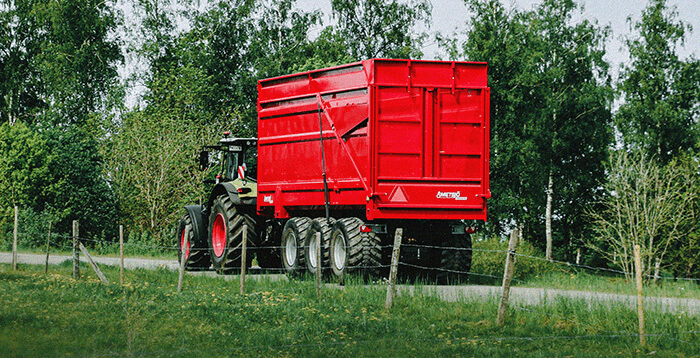

Container exchange is one of the most demanding operations with a tractor-drawn hook lift trailer – and one of the moments where the risk of serious accidents is greatest. The force that arises when a heavy container is lifted onto the hook lift trailer loads the drawbar connection in a way that neither the tractor nor the coupling is designed to handle without the right safety system. Despite this, most hook lift trailers on the market lack complete protection against this force.
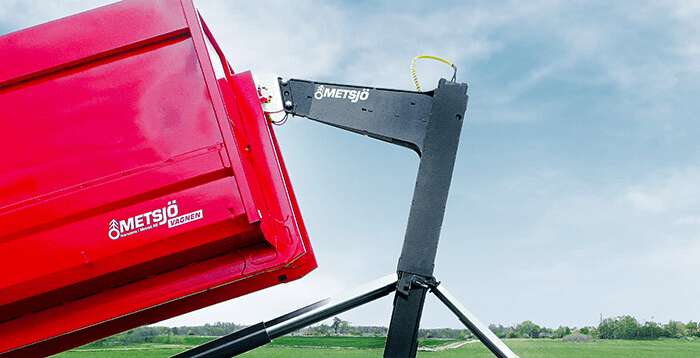
On Metsjö's larger hook lift trailers, a hydraulic safety support beam at the rear is standard. It is EU type-approved as an underrun protection device – and simultaneously eliminates the negative drawbar load during container exchange. One component doing two critical safety jobs. It is a solution unique to the market.

When a heavy container is exchanged onto a tractor-drawn hook lift trailer, a physical force arises that most farmers never see but that every designer must solve: a negative force at the drawbar – also known as negative drawbar load. It pulls the tractor's coupling backwards and upwards – in a direction that neither the tractor drawbar nor the top link bracket is designed to handle without the right safety system. With other makes of tractor-drawn hook lift trailers, serious accidents have occurred as a result of exactly this – where the coupling lifts, the tractor's rear wheels rise from the ground and the coupling risks coming loose. Metsjö's hydraulic safety support beam is designed to actively prevent this force sequence from occurring.
The fact that certain manufacturers on the market have now begun communicating about negative drawbar load confirms that the problem is real and well-known in the industry. But knowing about a problem is not the same as solving it – and the difference between minimising and eliminating the negative drawbar load can in the worst case be the difference between a safe and an unsafe container exchange.
When the hook lift trailer's telescopic tower rises and the hook grips the container, a force couple is created. The tower's movement upward and forward – described in detail in the geometry article – creates a reaction force upward and backward in the drawbar connection. When exchanging heavy containers – such as full grain containers or heavy machinery – this negative drawbar load can amount to several tonnes.
The problem is that the tractor drawbar and coupling eye are designed to pull forward – not to receive large forces backward and upward. If the drawbar is overloaded, the consequences can be serious:
Most operators of tractor-drawn hook lift trailers have experienced how the tractor's rear wheels lighten slightly when a heavy container begins to be lifted – a well-known sensation that shows that negative drawbar load is a real and tangible phenomenon, not a theoretical problem. In normal circumstances this movement is manageable. But when exchanging very heavy containers, with incorrect positioning or inadequate safety systems, the force sequence can escalate uncontrollably.
Before the safety support beam is even activated, Metsjö's base design has already minimised the negative drawbar load. Several design choices work together:
The pivot point positioned in front of the rear axle – when the tower's pivot point sits in front of the rear axle, the vertical component of the tower force creates a downward moment at the drawbar that counteracts the negative drawbar load. Competitors that position the pivot further back – or behind the rear axle – instead get a system where the tower force amplifies the negative drawbar load.
Rear axle positioned as far back as possible – the container weight lands on the roller behind the rear axle. The further back the axle sits, the shorter the moment arm between the roller and the axle – and the less negative drawbar load arises. More of the container weight is taken up by the axle and less loads the drawbar.
Hydraulic suspension with chassis lowering – by lowering the chassis via the hydraulic suspension before exchange, the drawbar height is reduced, the tower's pivot height changes and the axles' load absorption improves. Together this further reduces the negative drawbar load.
Shorter overall length – Metsjö's trailers are constructionally shorter than many competitors' – partly thanks to the long telescopic tower described in the tower article. This gives better geometric proportions and contributes to lower negative drawbar load during exchange.
Low chassis height – Metsjö builds the lowest hook lift trailers on the market, described in detail in the build height article. A lower drawbar reduces the moment arm for the horizontal forces in the system and contributes together with the other design choices to keeping the negative drawbar load as low as possible.
Metsjö's safety support beam is therefore the final element in a system that starts with a base design that already minimises the negative drawbar load from the outset – and then eliminates what remains via the ground support.
Most competitors solve the problem with a mechanical or hydraulic connection to the tractor's top link bracket. The system braces against the tractor from above and is intended to absorb the negative drawbar load via the upper link of the three-point lift. Other manufacturers use a cylinder that pushes down on the rear axle to reduce the force.
There are serious problems with all of these solutions:
The top link bracket is awkward to connect. It requires the trailer and tractor to be positioned exactly straight relative to each other. In practice this is time-consuming and frustrating in the field.
Requires tractor modification. The top link bracket varies between tractor makes and models. In some cases modification of the tractor is required for the system to work correctly.
No passive protection in case of hydraulic failure. If the hydraulic cylinder in the top link system fails during exchange, there is no passive protection. The negative drawbar load is transferred directly and uncontrollably to the tractor.
Cylinder on the rear axle reduces but does not eliminate. A cylinder pushing down on the last axle reduces the negative drawbar load but does not eliminate it. At the heaviest loads the protection is insufficient – and the solution does not work on trailers with parabolic suspension without a separate additional construction.
On MetaFlex 50–65 and larger models, a hydraulic ground support at the rear – a hydraulic safety support beam – is standard. The component is EU type-approved as underrun protection and simultaneously serves the function of eliminating negative drawbar load – two critical safety functions in one and the same construction. No extra hydraulic connection is required – the system is smartly connected together with the chassis control and the steering's hydraulic connections. No competing solution meets both safety requirements simultaneously.
The principle is simple but effective: instead of trying to absorb the negative drawbar load via the tractor, it is eliminated at the source by giving the hook lift trailer its own support point in the ground.
How the system works:

Before exchange, the safety support beam is hydraulically lowered to approximately 10 cm above the ground. The trailer can still roll in this position – the container exchange takes place with rolling movement for a smoother and more controlled process. When the container reaches the rollers and begins to compress the wheels, the negative drawbar load is at its greatest. It is precisely at this moment that the beam reaches the ground and absorbs the force – without loading the tractor.
The system is equipped with a hydraulic cylinder on each side of the support beam – two separate cylinders providing robust and symmetrical force absorption against the ground.
The result is that the negative drawbar load is eliminated, the tractor is actively protected and the entire exchange process becomes safer and more controlled.
Automated function via ISOBUS and remote control
For those with ISOBUS or remote control, the movement of the support beam down and up can be automated as part of the exchange process – the operator does not need to actively think about it. The safety support beam lowers automatically before exchange begins and rises when exchange is complete, making the entire operation smoother and reducing the risk of the step being forgotten.
Additional safety margin with hydraulic suspension
On MetaFlex models with hydraulic suspension, the chassis can additionally be lowered on the axles via the suspension before exchange. This provides three parallel advantages:
The combination of hydraulic ground support and chassis lowering via hydraulic suspension provides a dual protection system that no other manufacturer on the market offers.
Metsjö's commitment to EU type-approval runs through the entire MetaFlex programme. In addition to the safety support beam being EU type-approved as underrun protection, all MetaQ models and MetaFlex models with hydraulic suspension are EU type-approved for travel at up to 60 km/h. This means Metsjö's safety solutions are not only designed to work – they are certified to meet the most stringent European requirements.
For those who wish to operate with the safety support beam fully at ground level throughout the entire exchange process, Metsjö offers an optional roller (art. no. 143581) mounted on the beam. This makes it possible to roll the trailer with the beam fully lowered – without friction against the ground.


The safety support beam can be combined with Metsjö's EU type-approved hydraulically extendable rear underrun protection (art. no. 173137). The protection extends 833 mm and is equipped with a safety function that prevents tipping or exchange from taking place when the underrun protection is extended.

The purpose of the extendable underrun protection is to enable transport of longer containers – opening up new possibilities for transporting exceptionally large loads. Read more about this in our news article on MetaFlex 50 m transport capacity.
| Feature | Metsjö MetaFlex | Top link bracket (competitors) | Cylinder on rear axle (competitors) |
|---|---|---|---|
| Eliminates negative drawbar load | Yes – actively via ground support | No – transfers force via tractor | No – only reduces partially |
| EU type-approved safety component | Yes – underrun protection + ground support | No | No |
| Requires exact positioning when connecting | No | Yes | No |
| Requires tractor modification | No | Often | No |
| Two separate cylinders for symmetrical force absorption | Yes | No | No |
| Works with all suspension types | Yes | Yes | Partially – not parabolic suspension without additional construction |
| Allows rolling during exchange | Yes | Yes | Yes |
| Automation via ISOBUS/remote control | Yes – beam lowers and rises automatically | No | No |
| Base design minimises negative drawbar load | Yes – pivot, axle placement, chassis height, length | No | No |
| Standard on model | MetaFlex 50–65 and larger | Varies | Varies |
What is negative drawbar load?
Negative drawbar load – also known as negative tongue load – is the backward and upward force that arises at the drawbar connection when a heavy container is exchanged onto a hook lift trailer. The tractor drawbar and coupling eye are designed to pull forward – not to receive large forces in the opposite direction. Without protection, the drawbar can be overloaded or in extreme cases cause the tractor to lift from the rear.
Why is a top link bracket not sufficient?
The top link bracket is awkward to connect, requires exact straight positioning relative to the tractor, may require tractor modification and lacks passive protection if the hydraulic cylinder fails. It also transfers the negative drawbar load to the tractor rather than eliminating it.
What is the difference between Metsjö's ground support and a cylinder on the rear axle?
A cylinder on the rear axle pushes the axle down and reduces the negative drawbar load – but does not eliminate it. At the heaviest loads the protection is insufficient, and the solution does not work on trailers with parabolic suspension without additional construction. Metsjö's hydraulic ground support gives the hook lift trailer its own support point in the ground and eliminates the negative drawbar load at the source – regardless of axle configuration and load weight.
Do other manufacturers know about the problem of negative drawbar load?
Yes – the problem is well-known in the industry and certain manufacturers now communicate that their systems minimise the negative drawbar load at the drawbar. But minimisation is not elimination. Metsjö's hydraulic ground support is the only solution that eliminates the negative drawbar load at the source – regardless of load weight and suspension type – and that is simultaneously EU type-approved as underrun protection.
Why does Metsjö position the tower pivot in front of the rear axle?
The pivot point's position in front of the rear axle means that the vertical component of the tower force creates a downward moment at the drawbar that counteracts the negative drawbar load. Competitors with the pivot further back or behind the rear axle instead get a system where the tower force amplifies the negative drawbar load – requiring stronger compensation solutions.
What does it mean that the safety support beam is EU type-approved?
The safety support beam is EU type-approved as underrun protection – meaning it meets the statutory requirements for protection against rear underrun. At the same time it serves the function of eliminating negative drawbar load during container exchange. One component meeting two critical safety requirements – something no competing solution does.
Why does the support beam have cylinders on both sides?
The safety support beam is equipped with a hydraulic cylinder on each side – two separate cylinders providing symmetrical and robust force absorption against the ground. This ensures the beam absorbs the negative drawbar load evenly and stably regardless of how the container is loaded.
On which models is the safety support beam standard?
The hydraulic safety support beam at the rear is standard on MetaFlex 50–65 and all larger MetaFlex models.
Do I need to think about lowering the support beam before each exchange?
Not if you have ISOBUS or remote control – the movement of the beam down and up can then be automated as part of the exchange process. Without automation we recommend the support beam be lowered to approximately 10 cm above the ground before exchange begins.
Can I roll during exchange with the support beam lowered?
Yes – we recommend the support beam be held approximately 10 cm above the ground during exchange, which allows rolling. With the optional roller (art. no. 143581) the beam can be fully at ground level throughout the entire exchange process.
What does chassis lowering with hydraulic suspension do during exchange?
Lowering the chassis via the hydraulic suspension before exchange lowers the centre of gravity, increases exchange force and stability and further reduces the negative drawbar load. In combination with the safety support beam this provides a dual protection system unique to the market.
Can the safety support beam be combined with extendable underrun protection?
Yes – the beam can be combined with Metsjö's EU type-approved hydraulically extendable rear underrun protection (art. no. 173137, extension 833 mm) for transport of longer containers. A built-in safety function prevents tipping or exchange from being activated when the underrun protection is extended.